




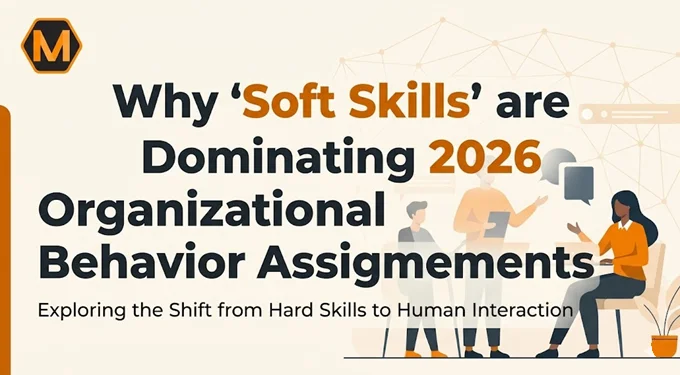
In the rapidly shifting corporate landscape of 2026, the global business environment has undergone a digital transformation that few could have predicted a decade ago. While high-speed automation and generative AI have taken over the heavy lifting of data processing, technical coding, and administrative logistics, a surprising trend has emerged in the academic world: the total resurgence of the “human element.” If you walk into any business school today, you will notice that the most challenging and high-stakes modules are no longer just about financial modeling or supply chain mathematics. Instead, Organizational Behavior (OB) has taken center stage as the most critical subject for future leaders. Professors are increasingly tasking students with understanding the invisible threads that hold a remote, diverse team together, making soft skills the ultimate currency of the modern workplace.
Managing these complex human dynamics requires a deep dive into psychological frameworks that can often feel overwhelming to a full-time student balancing multiple modules. Many researchers and academic consultants have noted that when students feel bogged down by the sheer volume of case studies and leadership theories, seeking professional assignment assistance from experts at myassignmenthelp can provide the necessary structural clarity and research depth to succeed. By focusing on the “why” behind human interaction rather than just the “how” of technical tasks, these services help students bridge the gap between abstract management theories and the practical, messy realities of a 2026 office environment. This balanced approach ensures that the academic output is both technically sound and emotionally resonant.
The Shift from Technical Prowess to Emotional Intelligence
For decades, the “hard skills” of programming, accounting, and data analysis were seen as the only guaranteed tickets to a high-paying career. However, as we move through 2026, those skills are increasingly viewed as “entry-level” requirements—tasks that AI agents can now perform with 99% accuracy. What AI cannot do—at least not with genuine nuance—is navigate a high-tension boardroom meeting, settle a cultural dispute between international departments, or provide comfort to a team during a corporate merger. This is why Goleman’s Emotional Intelligence model is being cited more than ever in current college papers.
Modern business assignments now ask students to analyze “Social Awareness” and “Relationship Management” within hybrid work models. We are no longer just looking at how a manager gives orders; we are looking at how a leader builds Psychological Safety. This concept, which refers to an environment where employees feel safe to take risks, voice concerns, and admit mistakes without fear of retribution, has become the cornerstone of organizational success in the post-AI era.
The Core Pillars of 2026 Organizational Behavior
To understand why these topics are dominating syllabi, we must look at the specific soft skills being tested in modern business modules:
Soft Skill Category
Academic Framework
Real-World Application 2026
Active Listening
Rogers’ Client-Centered Theory
Reducing turnover in remote teams by validating employee concerns.
Conflict Resolution
Thomas-Kilmann Model
Navigating disagreements between human staff and AI-integrated workflows.
Cultural Intelligence
Earley & Ang’s CQ Model
Managing global “Digital Nomad” teams across different time zones and values.
Cognitive Flexibility
Dual Process Theory
Quickly pivoting business strategies when market algorithms shift overnight.
Why “Cognitive Flexibility” is the New Strategic Advantage
The 2026 business environment is characterized by what experts call “perpetual change.” A company might be using one project management software on Monday and pivoting to a completely different AI-integrated ecosystem by Friday. In this atmosphere, Cognitive Flexibility—the mental ability to switch between different thinking patterns and adapt to new information—is a vital soft skill. In Organizational Behavior assignments, this is often explored through the lens of Transformational Leadership.
Students are now tasked with evaluating how leaders can inspire a workforce that is suffering from “tech fatigue.” It is no longer enough to be a “Transactional Leader” who simply trades paychecks for performance. Today’s assignments require a deep understanding of how to motivate a multi-generational workforce, ranging from Gen Alpha interns who value social impact to Baby Boomer consultants who value legacy. To excel in these papers, one must master the art of “Active Listening” and demonstrate how interpersonal dynamics directly impact a company’s bottom line.
If you are struggling to map out these intricate leadership theories into a cohesive, high-scoring report that meets the rigorous standards of your university, utilizing business assignment help is an effective way to ensure your arguments are backed by the latest peer-reviewed journals and 2026 industry data.
The Rise of “Empathy-Driven” Management Models
One of the most significant changes in 2026 assignments is the move away from the “Heroic Leader” myth. In the past, business papers focused on a single CEO making all the decisions. Today, the focus is on Distributed Leadership and Servant Leadership. This shift recognizes that in a complex, fast-paced world, no one person has all the answers.
1. The Death of the “Top-Down” Authority
The traditional “boss” who sits in a corner office and barks orders is a relic of the past. In 2026, assignments focus on how managers act as facilitators. In OB coursework, students are asked to simulate conflict resolution scenarios where empathy is used as a strategic tool. For example, a common assignment might ask: “How does a manager maintain team cohesion when 40% of the workforce is automated?” The answer lies in soft skills—ensuring the remaining human staff feel valued, creative, and safe.
2. Navigating the “Chaos Culture”
With the rise of short-form media and instant gratification, the human attention span has changed. Organizational Behavior now studies how to maintain “Deep Work” in a world of constant digital distraction. Assignments often require students to design “Attention Management” policies for corporations. This involves a mix of psychology, office design, and interpersonal communication.
The Intersection of Workplace Culture and Lifestyle Aesthetics
A fascinating development in 2026 is the intersection of “Workplace Culture” and “Lifestyle Aesthetics.” Students are now exploring how the physical and digital environment—often called the Cozy Productivity Trend—affects employee retention and mental health. Organizational behavior is no longer confined to a physical office building; it’s about the “vibe” of the digital workspace.
Assignments are focusing on Human Capital in a way that includes radical transparency and mental wellbeing. You might be asked to write a case study on “Digital Detox Policies” or “Asynchronous Communication Protocols.” These topics require a sophisticated understanding of how human beings interact with technology without losing their sense of identity. It’s about finding the “Sweet Spot” between high-tech efficiency and high-touch humanity.
Technical Keyword Mapping for Business Students
To help you organize your thoughts for your next major paper, consider this “Keyword Cluster” approach. Using these terms correctly shows your professor that you are current with 2026 academic trends:
The Resilience Cluster: Mental Toughness, Adaptability Quotient (AQ), Stress Management, Work-Life Integration.
The Collaboration Cluster: Cross-Functional Teams, Virtual Synergy, Peer-to-Peer Mentoring, Collaborative Intelligence.
The Ethics Cluster: Algorithmic Bias, Ethical Leadership, Corporate Social Responsibility (CSR), Transparency.
By weaving these clusters into your writing, you demonstrate a “Topical Authority” that proves you aren’t just memorizing definitions from an old textbook, but are actually engaging with the global shift in how humans work together.
Conclusion: Preparing for a Human-Centric Future
As we look toward the end of the 2020s, it is clear that the “Soft Skill Revolution” is not just a temporary academic phase. It is a fundamental realignment of what it means to be a professional in a world where machines handle the logic and humans handle the magic. Organizational Behavior assignments in 2026 serve as the ultimate training ground for the leaders of tomorrow—leaders who will be defined not by their ability to crunch numbers, but by their ability to connect, inspire, and lead with genuine heart.
Whether you are analyzing Maslow’s Hierarchy for a modern remote team or exploring the nuances of Interpersonal Dynamics in a decentralized autonomous organization (DAO), remember that the goal is to solve “Human Problems” with “Human Solutions.” While the tools we use—AI, VR, and automation—will continue to change, the core of business will always remain the same: people working with people to achieve something greater than themselves.
Frequently Asked Questions
Why are interpersonal skills more valuable than technical skills in 2026?
While automation handles data and logic, humans are still required to manage complex emotions, settle high-stakes disputes, and lead diverse teams. Technical skills are now considered the baseline, while the ability to connect and inspire is what defines a successful leader.
What is “Psychological Safety” in a modern office?
It is a workplace culture where team members feel secure enough to take creative risks and admit to mistakes without fear of punishment. This environment encourages innovation because employees aren’t afraid to voice unconventional ideas or ask for help.
How does “Cognitive Flexibility” help in a shifting market?
This skill allows a person to quickly abandon outdated strategies and adopt new technologies or workflows. In a fast-paced economy, the mental agility to pivot between different thinking patterns is a major competitive advantage.
Can soft skills actually be measured in academic assignments?
Yes. Modern evaluations use case study simulations and behavioral analysis to see how a student applies theories like Emotional Intelligence or Servant Leadership to solve realistic workplace conflicts and team dynamics.
About The Author
Min Seow is a dedicated content strategist and academic consultant specializing in modern management trends. With a focus on the intersection of human psychology and corporate efficiency, Min provides expert insights into how leadership evolves in a digital age. Representing myassignmenthelp, Min is committed to helping the next generation of professionals master complex organizational theories and achieve their academic goals.
Learn something new every day—dive into our latest expert-driven posts.